The Rosewoods

There is a tree which is often mistaken for Indian Rosewood due to striking similarity in their leaves and flowers. But can be distinguished by somewhat darker bark.

Black Rosewood (Dalbergia Latifolia/काळा शिसम, काळारुख) is moderate-to-large sized tree with a dome shaped crown of lush green foliage. The leaves of Shisham have pointing tip whereas the leaves of this species are blunt and broadly rounded with wavy margins. The broad leaves explains the species name latifolia.

Furthermore, though it sheds its leaves, it can hardly be found leafless. It flowers abundantly in aromatic clusters of white colour creating an eye-soothing view. Due to these reasons, it is noted to attract number of birds, butterflies, insects and wildlife. Hence the tree needs to be introduced in home gardens in urban societies. 

Practically, Black Rosewood is quite similar to Shisham, including their use in agroforestry, apiculture, medicines, ornamental or soil improvement. It is also a Nitrogen-fixing tree and gives the nitrogen-rich foliage which is widely used as a green manure and fodder. Like other member of the genus Dalbergia, its honey is dark amber and strong flavoured.
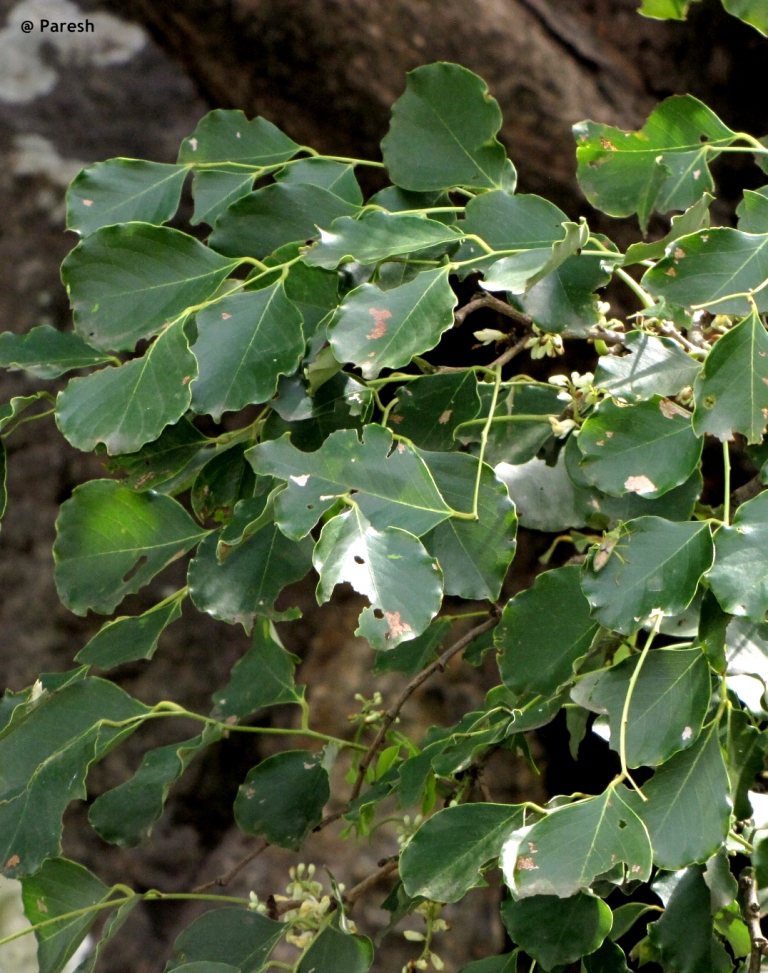
In a drier habitat, the hardy tree is leafless for couple of months, regaining its leaves in April-May. In a moist locality, it is evergreen throughout the year. The species grows on a variety of soils. It grows best on well-drained, deep, moist soils & black cotton soils. The root system of the tree is well developed with deep tap roots and long lateral roots. It reproduces by seed, root sucker or cuttings. Although no treatment is necessary, soaking seed in cool water for 12-24 hours will hasten germination of seeds. 

Black Rosewood is widely used for reforestation of eroded soils. It is also planted as a roadside tree and shade tree. It acts as a soil improver. The leaf litter decomposes slowly releasing nutrients gradually and it is used as mulch. Medicines are made from the tannins in the bark, for diarrhoea, worms, indigestion, and leprosy. These tannins also produce an appetizer.

There is another species from the same genus, Dhobin or Phansi (Dalbergia Lanceolaria subsp. Paniculata/धोबीन, फणशी, दोंडूस) is a very conspicuous and handsome, deciduous tree. It is eye as well as ear catching tree when profusely covered with flowers and young leaves. The tree is actually loud with the buzzing of thousands of bees. Its flowers are white & fragrant.

This species is a moderately fast growing tree. It is recommended for reforestation projects on degraded land where seeds are unlikely to grow successfully. It is propagated by seeds. Young seedlings grow well in the dappled shade of the forest, but they become more light-demanding as they grow older. 

Different parts of trees particularly seed and bark are used in the Ayurveda; mainly to treat arthritic infections and inflammations.

The lesser known tree species has a great potential in Agroforestry. Dhobin has a symbiotic relationship with certain soil bacteria, these bacteria form nodules on the roots and fix atmospheric nitrogen. Some of this nitrogen is utilized by the growing plant but some can also be used by other plants growing nearby. In  other uses, it is used as wind  break for micro-climate enhancement, nectar source for honeybees, and in addition to these leaves are used as a fodder for livestock animals. 

Both these Rosewoods are excellent choice for farmers as well as city dwellers!

Dridhataru...The Robust Tree!

The Button tree or Dhok (Anogeissus Pendula/धोककाळा धावडा) is a beautiful, moderate-sized species. With or without flowers, the tree is known for grace and beauty of its silky foliage. In winters before falling, the leaves turn a beautiful yellowish red. Every time you visit the tree, it appears surprisingly different!

Dhok is often confused with well-known Dhvada tree or rather, is recognized as Dhavda. It has variable bark. Dhok has tiny fragrant flowers in dense clusters. It is a dominant species on sloppy & rocky soils, as nothing else can survive there. It coppices & pollards well and the coppice shoots are fairly fast growing, although the tree grows slowly. It fruits abundantly but has low germination rate. 

Despite having such a low regeneration capacity and a very tough growing conditions, the tree does something spectacular to regenerate. Mr. Pradip Krishen, the writer & environmentalist, finds the tree very unique and pretty. Under the soil surface, a tree sends out a horizontal stem, called a ‘stolon’ and from the end, a sapling roots. Such stems extend in every direction, spawning a colony of genetically identical trees. “It’s like the trees are holding hands. Button tree is more like a Banyan, which instead of sending aerial roots down, sends subterranean shoots up.” says Krishen. 

Dhok is a very important tree species of the fragile eco-systems. It is a drought hardy plant that yields excellent animal fodder and other products like green dye and tannins. The tree is also known for many medicinal properties and has uses for ailments like dysentery, gastric disorders, skin problems, cough or for its anti-oxidant properties. 

It has ecological significance for the Aravalli range and other hilly areas of the country, where it is difficult for other tree species to thrive. It is a hardy tree that can survive even in the extreme conditions.

Axlewood tree or Dhavda (Anogeissus Latifolia/धावडा, धव) is a similar beautiful species from same genus. It is a medium-to-large sized, deciduous tree.

It is one of the most useful multi-purpose trees in India. Axlewood also has tiny beautiful fragrant flowers in dense clusters. But flowerless tree is also equally attractive, mainly due to the bark. Its bark surface is smooth or with scales, pale to dark gray and is mottled in a characteristic pattern. It has somewhat similar flowers and fruits as that of Dhok. Leaves are nearly opposite on drooping branches. 

The drought tolerant tree is also fire-resistant, but does not tolerate water-logging. It is found on a variety of soils, but prefers deep alluvial soils. The tree’s robust nature gives it the Sanskrit name Dridhataru! :)

It is usually mentioned as a possible agroforestry species. Tussar silkworms are fed on its foliage, which is also used as fodder for cattle and buffaloes. Its flowers are an important pollen source for bees. The tree is a good survivor on eroded land. It is often used for river bank stabilization. The tree improves the quality of soil wherever planted. Axlewood tree contributes to soil nutrient cycle by exhibiting high leaf-litter decomposition rates. Its leaves contain large amounts of tannin. The tree is the source of Indian gum, also known as Ghatti gum. Ghatti gum is a good substitute for Gum-arabic and is used in printing, for confectioneries, in dye processes and as a binding agent in pharma industries. It also gives good quality charcoal.

Medicinally, the plant root pacifies vitiated kapha, vata and abdominal disorders. The bark cures vitiated conditions of kapha and vata, wounds and ulcers, inflammations, diabetes, haemorrhages, haemoptysis, diarrhoea, dysentery, haemorrhoids, skin diseases, liver diseases and general debility. Also it is reported to be used in treating snake bites and scorpion stings in India.

Axlewood can be propagated by seeds and coppices. The seeds are soaked in cold water for about 48 hours or 3-min hot water treatment is done for successful germination. The tree produces root suckers, coppices and pollards well.

Both these trees deserve far more attention as an ornamental and ecologically important trees. May be that's why these trees got their place on the 11th anniversary of Gifting Trees...! :-)

Going Back to a Simple Lifestyle...

In our world of excessive stuff, there's a silent movement towards minimalistic living that's gaining momentum. A movement related to living simply is Minimalism, where the focus is on living with less, compared to simplicity, which strives for living a less complex life. The two works quite well together. A growing number of people in urban cities are questioning whether they need as much as they have: clothes, accessories, gadgets and everything that fills our homes but doesn't necessarily serve us better or make us happy. People are embracing simplicity of living. In other words, they are developing the art of living with less, going back to our rustic roots. 

One who have experienced this simplicity, have to admit certain things. First, voluntary simplicity can help mitigate the effects of climate change and other environmental problems. Secondly, if we cut out the things that we don’t need, then the quality of our lives will improve drastically. And lastly, living more simply increases the spiritual dimension of our lives as we get more time for self reflection. Voluntary simplicity fits well the category of sustainable consumption because its principles include: creating economically sustainable future, shaping balanced relationships between humans as well as building and maintaining close ties to the mother Nature. 

In economics, there is a Law of Diminishing Marginal Utility which states that the marginal utility of a good or service declines as its available supply increases (Utility is the satisfaction or benefit derived by consuming a product). In simple words, if we consume or have more commodities, they become less valuable or less satisfying. More & more things or loads of stuff is not going to give you eternal satisfaction and peace. The law is known also as Fundamental Law of Satisfaction. Voluntary simplicity is an exact oppositional living strategy that rejects the high-consumption, materialistic lifestyles of consumer cultures and affirms what is often just called ‘the simple life’ or ‘downshifting.’

This does not necessarily mean that we should leave everything and become a cave-dweller, nor there should be the complete absence of technology. Out of many people who simplify, still continue to live conventional lives, working for a living, raising families, exploring spiritual interests, connecting with their communities, and enjoying leisure time.

While writing this Voluntary Simplicity series, I used to realize that many things or stuff I have are actually an futile, useless or have a very short lifespan; but their manufacturing process either pollutes unnecessarily or consume too much resources and energy or both. So when I actually give it a thought, we all are surrounded by such stuff. For me, I have decided to gradually decrease the stuff around me and move slowly towards Simplicity.

I have realized that it is a deliberate choice to live with less in the belief that more life will be returned to us in the process. According to the most prominent historian of the Simplicity Movement, David Shi, the primary attributes of the simple life include: thoughtful frugality; a suspicion of luxuries; a reverence and respect for nature; a desire for self-sufficiency; a commitment to conscientious rather than conspicuous consumption; a privileging of creativity and contemplation over possessions; an aesthetic preference for minimalism and functionality; and a sense of responsibility for the just uses of the world’s resources. More concisely, Shi defines voluntary simplicity as ‘enlightened material restraint.’

Yes..! Even You can be happy with little. But today, we have already perfected the art of being unhappy with much - or too much. Out of our selfish greed rather than the higher values, in search of petty pleasures rather than some worthwhile accomplishments, we have critically jeopardized the planet’s life-cycles and caused species to fall extinct at a frantic pace. We must return to ancient India’s philosophy of simple living, else the collapse of our artificial system may one day force us to it. Our small everyday choices are blind and market-driven; let us make them enlightened.

The crux of the issue is the reduction of toxic loads that surrounds us. Natural living, changes every facet of life. It restrains unhealthy behavior, and build up of nasty toxins associated with hectic lifestyles. Living pure in every small way of daily living becomes the primary goal. This is appealing as it saves money, reduces stress and achieves good health. But how does one get started? Do you have to stop shopping completely and stop washing yourself, your clothes and homes because everything out there is a potential threat? Absolutely not! unless, you want to use that as an excuse to do nothing. You can try and become self-sufficient or self-dependent. Instead of automated electrical equipment, try to use mechanical or manual one which requires physical strength to operate. For example, skip the escalator and take the stairs.

In the end, The Choice is Yours - Simplicity or Complexity? Would you prefer to live a life of simplicity or a life of complexity? Well, that might depend on your views of simplicity. And you can choose any reason for opting - personal, social, humanitarian, or ecological! We all can live meaningful, free, happy, and infinitely diverse lives, while consuming no more than a sustainable and equitable share of nature. That, at least, is the challenging ideal which seems to motivate and guide many of its advocates and practitioners.