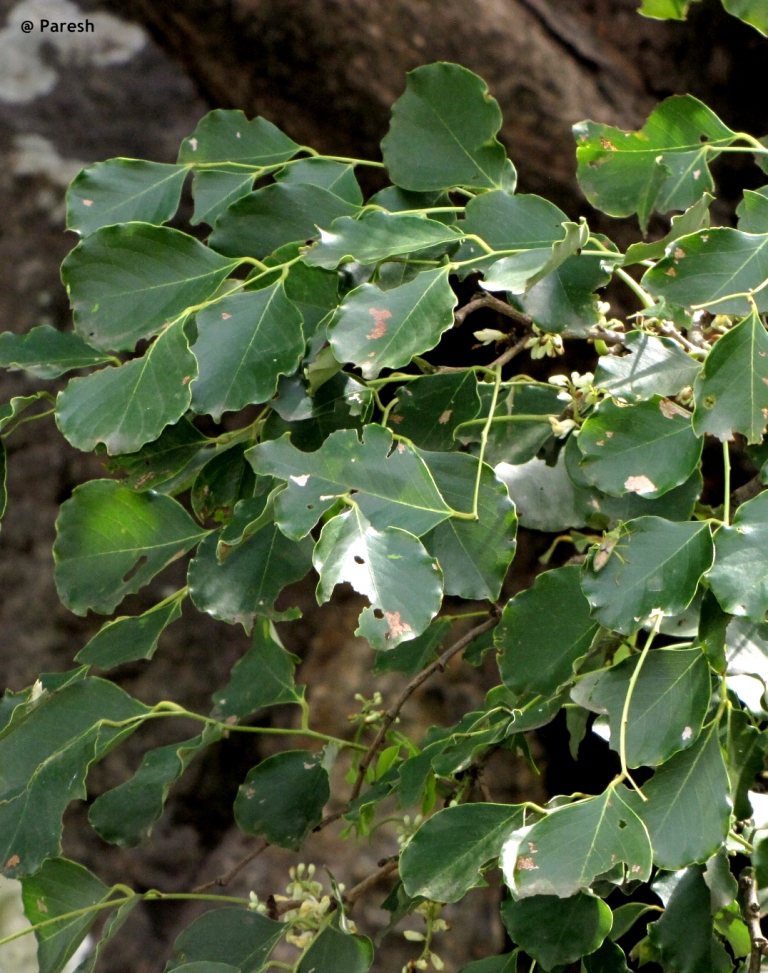
Teak (Tectona Grandis/सागवान,
साग) is a tall, deciduous tree,
having small, beautiful fragrant white flowers and large leaves. Flowers
usually appear during the rainy season, and trees tend to flower synchronously. It grows moderately fast and has open crown open with many small branches; the bole is often buttressed and may be fluted with deep root system.

Though not a
garden plant precisely, it has high ornamental value. It is a very important candidate in an ecosystem with a long life span. Due to its
tall growing nature, it is a preferred roosting and nesting site for number of
birds. Teak tree is visited by number of insects too. It is pollinated by
black-ants, flies and particularly by bees. Teak is also used as a food plant
by the larvae of moths of the genus Endoclita including E. aroura, E. chalybeatus,
E. damor, E. gmelina, E. malabaricus, E. sericeus and E. signifer and other
Lepidoptera including Turnip Moth. :-)
 Teak trees survive and grow under a wide range of climatic and soil conditions. It is light-demander species. Each pair of its leaves is arranged at 90° to the adjacent pair, so as to maximize their ability to receive & trap sunlight. It grows best in a warm, moist, tropical climate with a significant
difference between dry and wet seasons. It is a hardy species which is the first to colonize barren environments or previously bio-diverse ecosystems that have been
disrupted, such as by fire. Even young plants show a remarkable capability to recover after fire. Hence Teak is known as a Pioneer species. In contrast to other pioneer species, it is able to
persist, dominate and to naturally regenerate towards the climax phase of
succession in most parts of its natural range. It occurs naturally in various
types of tropical deciduous forests. It is
often a dominant member of a mixed deciduous forest, where its main associates
are Shorea Robusta, Terminalia spp., Xylia spp., Lagerstroemia spp., Haldina, Dalbergia Latifolia, Bambusa Bambos and Dendrocalamus Strictus.
Teak trees survive and grow under a wide range of climatic and soil conditions. It is light-demander species. Each pair of its leaves is arranged at 90° to the adjacent pair, so as to maximize their ability to receive & trap sunlight. It grows best in a warm, moist, tropical climate with a significant
difference between dry and wet seasons. It is a hardy species which is the first to colonize barren environments or previously bio-diverse ecosystems that have been
disrupted, such as by fire. Even young plants show a remarkable capability to recover after fire. Hence Teak is known as a Pioneer species. In contrast to other pioneer species, it is able to
persist, dominate and to naturally regenerate towards the climax phase of
succession in most parts of its natural range. It occurs naturally in various
types of tropical deciduous forests. It is
often a dominant member of a mixed deciduous forest, where its main associates
are Shorea Robusta, Terminalia spp., Xylia spp., Lagerstroemia spp., Haldina, Dalbergia Latifolia, Bambusa Bambos and Dendrocalamus Strictus. 
Teak is a suitable ideotype for agroforestry because of having deciduous nature, sparse canopy and deep root system. It may be planted as a wind break. Though it gives good quality charcoal, it is usually considered too valuable for it. It produces a yellowish-brown or reddish dye,
which is used for paper, clothes and matting.
 According to Ayurveda, it is acrid, cooling, laxative, sedative
to gravid uterus and useful in treatment of piles, leucoderma and dysentery. Flowers
are acrid, bitter and dry and useful in bronchitis, biliousness, urinary
discharges etc. Roots are useful in treatment of urinary system related
troubles. According to Unani system of medicine, the oil from flower is hair
promoter and useful in scabies.
According to Ayurveda, it is acrid, cooling, laxative, sedative
to gravid uterus and useful in treatment of piles, leucoderma and dysentery. Flowers
are acrid, bitter and dry and useful in bronchitis, biliousness, urinary
discharges etc. Roots are useful in treatment of urinary system related
troubles. According to Unani system of medicine, the oil from flower is hair
promoter and useful in scabies.
Teak is one of the most important timbers in the world - a
rare combination of superior physical & mechanical properties makes it a
paragon of timber, and there is no likelihood of it being eclipsed by any other. Teak is often grown in
botanical gardens and is occasionally cultivated in tropical countries as an
ornamental for its large leaves and spreading flower clusters.