Showing posts with label Pesticidal. Show all posts

The Complete Elm!

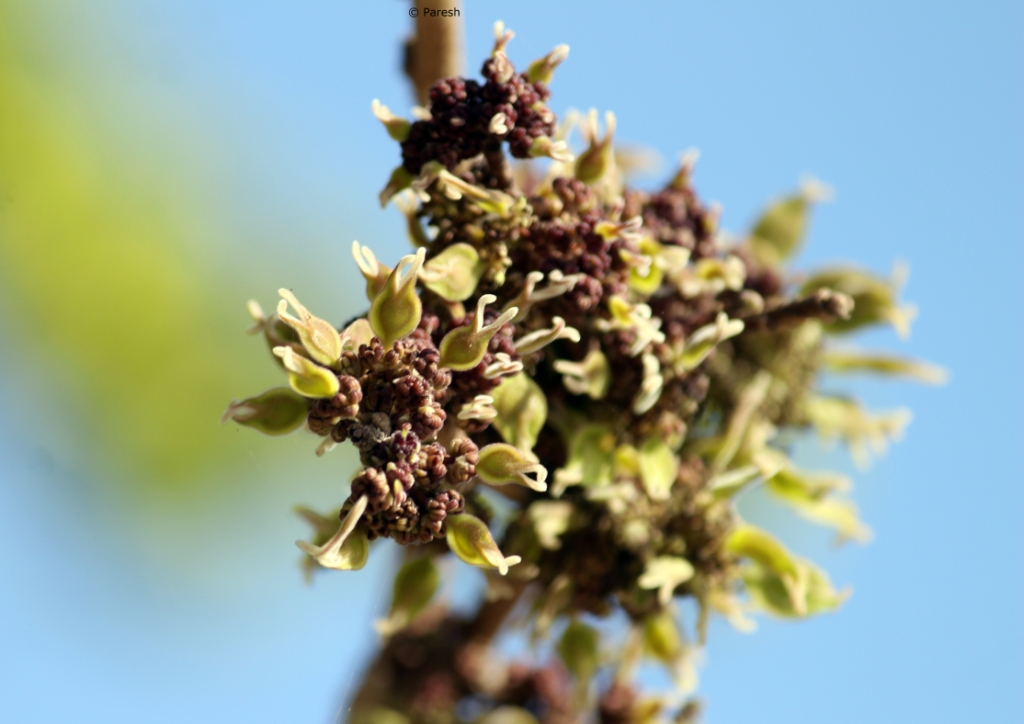
Indian Elm (Holoptelea Integrifolia/वावळ, पापडी) is a large deciduous, fast-growing tree with good canopy. It is densely foliated tree. Though its tiny flowers are not conspicuous, the circular samara fruits give an attractive appearance to the tree; also making the tree easy to spot. It has wind-pollinated male and hermaphrodite flowers. The flowers are small, greenish-yellow to brownish & pubescent.

Indian Elm tree flowers in January-February months and it fruits from March to May. During this period, the tree attracts loads bees and butterflies. It is the larval host plant for the Chilades Pandava butterfly. The fruits of Indian Elm, just like figs, are largely eaten by Langurs. The leaves are used as animal fodder. It can be coppiced. The unripe fruits are edible. Fruits also serve as a good source of Essential oils. This Elm gives good quality charcoal. 

Though Indian Elm grows slowly in initial stages, once established, the species can be fast-growing. It propagates from seeds & cuttings. The papery fruits can be just sprinkled on soil and regular water-spraying helps in their germination. It is resistant to gaseous pollutants. The tree is known to purify air by trapping dust & particulate pollutants. 

The tree is mentioned in Charaka-Samhita, Sushruta-Samhita and other traditional systems. It pacifies vitilated kapha and is known to be useful in skin diseases, haemorrhoids, colic, flatulence & vomiting. Its leaves are also used for diabetes, leprosy & baldness. This herb is also mentioned for the treatment of localized swelling, nausea, indigestion, rheumatism, ringworm infectin, scabies, ulcers and acts as blood purifier. The tree has also been found to have some antibacterial properties. Name the disease and this elm have remedy for that! It is commonly called Chirabilva in Ayurveda. 

Indian Elm is also used in ecological forestry for its heat & drought tolerance and regenerative abilities. It’s a very hardy tree that survives well in the extreme climate. Its root system helps in erosion control of soil and dune stabilization. The leaves also provide useful mulch in good quantity. It’s crushed leaves & bark has a characteristic smell. This virtue makes the tree resistant to pest and these parts can also be used as a pest repellent.

The tree is harvested from the wild for local use as a medicine, food, and as a source of oil and wood. The attractively dense tree is commonly spotted on roadsides across the city and in gardens as well. 

A Sword To Kill A Fly?

Do you face problems due to pests such as insects? What do you do to control these insects and to save your garden or farm?

We often resort to pesticides to deal with garden the pests. Let’s consider what happens when you attempt to poison pests. Pesticides don’t just control unwanted beetles and slugs. They often kill more than just the target nuisance, including beneficial natural predators like lady bugs. A general insecticide will kill the majority of bugs in an area, but more than 90 percent of them were beneficial or benign. Furthermore, if a pesticide gets into your soil, it may also harm soil organisms that help to keep your plants healthy. By their nature, pesticides present risk to animals, humans, and the environment because they are designed to harm living organisms. As time passes, they keep accumulating in our soil and water bodies.

In a balanced ecosystem, predators will be in the minority. In other words, in an environment, there are many more prey organisms to ensure a continuous food supply for the predators. In such an eco-system, there are huge numbers of prey including, aphids, white flies, cabbage worms, leaf miners, mole crickets, spider mites, and others that may be eating your crops, lawns, and landscape plants, but relatively few predator bugs such as assassin bugs and relatively few bug predators such as lizards, frogs, toads, birds and bats.

As your landscape recovers from the poisoning, bugs will begin to multiply again, but since you’ve killed off the beneficial insects that used to keep them under control, the predators that survived the poisoning have moved away to areas where they can make a living. Many harmful bugs, possibly including new pests that were previously controlled, will recover in even greater numbers than ever before. You spray again and the process repeats itself and each time the most damaging pests will recover in ever increasing numbers. Repeated poisonings often encourage resistance to that pesticide, and people then switch to even stronger poisons in higher concentrations. Thus, in short, you are choosing the most resistant pest to multiply and it is getting harder & harder to control these pests. 

It’s time to break that cycle of harmful pesticides and manage your landscape as a complete ecosystem by using Integrated Pest Management (IPM). Like an old Korean proverb - ‘Do not draw your sword to kill a fly’, there are many ways to control pests instead of resorting to pesticides. 

Relying on insect predators and other eco-friendly strategies to control your pests is not a matter of sitting back and doing nothing. As with any other effective gardening method, it requires awareness, education, experimentation, effort and patience. While it’s easy to recognize the larger pest predators, identifying the good & the bad bug is more challenging, but it’s a vital step for ecosystem gardening. Many insects that we see are actually beneficial, such as butterflies, bees, ladybugs, lacewings and fireflies. For Example, Butterflies & bees perform the important function of pollinating our crops and flowers, helping plants to reproduce. Lady Beetles and lacewings eat aphids, scale insects, plant-feeding mites and insect eggs.

We have to have it in mind that it is pretty natural to have a few bugs nibbling on your plants. If you keep your soil and your backyard ecosystem healthy, Mother Nature will normally keep things from getting out of hand. The discovery of one caterpillar in a row of thriving vegetables is quite natural. One possible solution is to expect and tolerate a certain amount of pest activity.

When control of pests is necessary, there are many options to choose from before resorting to pesticide. The best way to control pests is to head the problem off before it gets started. Plant a diversity of Native plants that bloom all year. Many predators supplement their diets with pollen and nectar, so the same blossoms which make your garden beautiful will tend to attract the insect predators that you need to defend it. One may also choose from wide range of cheap IPM methods like installing insect traps, pheromone kits etc. Plant some nectar-rich flora alongside the vegetables and along with beauty, you will get protection too! Try and find out which Good bugs are there in your garden...as they are working day & night to look after your garden!
Neem and Neem!

We all are aware of importance of the Noble tree Neem. Today we will get acquainted to two tree species which, though closely resembles Neem, are in no way related to it.

The Curry Leaf (Bergera Koenigii/कढीनिंब, कढीपत्ता) is a small evergreen tree which is a fast grower. It is known so because it has the 'leaf that is used to make curry' and it is present in almost all the dishes of Tamil Nadu state. In other states of India also, the leaves are a must and are absolutely necessary for the authentic flavour!

It is also known as Sweet Neem since the appearance of the leaves is similar to the unrelated medicinal Neem tree. Similarly in Gujarati, it is known as Meetho Leemdo (means Sweet neem). The leaves are highly aromatic. It is a good source of vitamin A, Calcium & Iron. The leaves primarily used in providing a flavour in Indian food. The flowers are small, white & fragrant. The small black shiny berries are edible and are very nutritious.

The Curry leaves are highly valued as seasoning or a natural flavouring agent in southern and west-coast Indian cooking, and especially in curries, though can be used in many other dishes to add spice like chutneys, soups, pickles, vegetables, buttermilk preparations etc.

The leaves and fruits are also used as a herb in Ayurvedic medicine. Their properties include much value as an anti-diabetic, antioxidant, antimicrobial, anti-inflammatory, hepato-protective, anti-hyper-cholesterolemic and many more. It can help in reducing blood sugar level. Curry leaves are cool, stimulant and also known to be good for hair, for keeping it healthy and long. It also helps prevent premature hair greying. A volatile oil extracted from leaves is used as a fixative for soap perfume. This plant is quite ornamental due to its compound leaves. It can, therefore, be used as a hedge and as an ornamental species. It is also known for its soil-binding ability, hence prevents soil-erosion.

Curry Leaf tree does not require much maintenance or care. The tree is easily propagated from its numerous root-suckers or seeds.

The other species which is frequently confused with Neem tree is Bead tree or Persian Lilac (Melia Azedarach/बकाणनिंब). It is a moderately-sized, fast-growing tree. Locally, it is also known as Bakain.

The tree appears very beautiful due its bright green foliage. It produces dense, shady and well rounded canopy. In landscapes, it is usually pruned to form an umbrella shape.
Bead tree is a tough survivor and is usually grown in gardens or as a street tree where it provides cool shade on hot summer days. The tree produces bright and lush green foliage in spring followed by beautiful clusters of tiny, pale-purple or lilac blooms that draw attention to their presence by their delightful fragrance. The cherry-like green fruits grown abundantly.

Like Neem, it is naturally resistant to pests, termites and fungal infection. Extract from the bark and fruit has pharmacological properties and is used to kill parasitic roundworms. It is well known for its medicinal uses. Its various parts have antihelmintic, antimalarial, cathartic, emetic properties and are also used to treat skin diseases. Seed-oil is used in rheumatism. Leaves and fruits are insect repellent. Dried ripe fruit is used as an external parasiticide.

The hardy tree is drought-tolerant and is easily propagated by seeds. It also withstand coppicing and lopping as for fodder and leaves are highly nutritious. It also gives good quality charcoal. Fruit stones make ideal beads and are used in making necklaces & rosaries.

Bead tree is a well-known ornamental avenue tree, for its scented flowers and shady, spreading crown. But it is also widely used as a shade tree in coffee plantations or as windbreak. It also provide abundant green manure.

It seems, its best to have these Neems! :-)

The Future of Biofuel

It must have been 40° C + outside, but when you spot this tree, it provide a nice green canopy and offer a cool, soothing welcome despite of the heat. Indian Beech tree, Karanj or Pongam tree (Millettia Pinnata/करंज) is an ever-green, moderated sized tree.

Pongam tree is very beautiful tree with attractive, showy, fragrant flowers; borne on racemes, are pink, light purple or white in colour. It attracts many small birds and butterflies like the Cerulean, Blue Tiger & Common Crows. They are considered good sources of pollen for honey bees. Many of these trees are just coming into bloom in the city. The flowers and new leaves generally appear together. When the trees are in flower the ground below them is usually carpeted with blooms. The flowers are used by gardeners as compost for plants requiring rich nutrients.

It is a very hardy tree and can adapt itself to varying conditions. Pongam tree can grow on most soil types ranging from stony to sandy to clayey, including Verticals. It does not do well on dry sands. It is highly tolerant of salinity and is an ideal candidate for saline soil reclamation. It is common along waterways or seashores, with its roots in fresh or salt water.

The tree is well suited to intense heat & sunlight and its dense network of lateral roots and its thick, long taproot make it drought-tolerant. The dense shade it provides slows the evaporation of surface water and its root nodules promote nitrogen fixation. Pongam tree is one of the few nitrogen fixing trees to produce seeds containing 30-40% oil.

The seeds has variety of uses. It yields thick reddish oil used for burning and for skin diseases as having bactericidal and anti-fungal properties. It also is very effective against white flies, mites and other sucking pests in all crops. In fact, almost every step in the life cycle of Pongam seeds results in a safe and useful product. Once the oil has been extracted from the seeds, the remaining seed-cake can be mixed with water and placed in an airtight environment where it ferments, producing a flammable gas and a slurry, which is a safe and highly effective organic fertilizer. The gas can be compressed and stored in small tanks for use as cooking fuel. (Biogas burns far cleaner than wood or cow dung, the traditional cooking fuels, and so causes fewer respiratory disorders.) Widespread use of gas for cooking could also help curb the rampant deforestation common to areas where wood is used as a primary fuel. The seed-cake has other uses as well.

Incorporation of leaves and the seed-cake into soils improves fertility. Dried leaves are used as an insect repellent in stored grains. The seed-cake, when applied to the soil, has pesticidal value, particularly against nematodes. Pongam tree is a fast growing tree which gives valuable fodder for livestock, especially in arid regions. They are also used as green manure. String and rope can be made from the bark fiber.

If that's not enough, the oil can also be used as Biodiesel in motor engines! Or rather, it is being used worldwide. Even in India, the Karnataka state transport department has operated buses on a diesel blended with 30% Pongam oil.

On a global scale, biofuels reduce the net emission of greenhouse gases, especially carbon dioxide. While it is true that any burning fuel releases carbon into the atmosphere, fossil fuels are composed of carbon previously stored below the earth’s surface in the form of oil, natural gas & coal, and as they burn they release a new load of carbon into the air. On the other hand, the carbon content of biofuels like Pongam oil has been taken directly from the atmosphere as the tree grows- on average, one hectare (2.47 acres) of Pongam tree absorbs 30 tons of carbon per year. Thus burning Pongam oil instead of fossil fuels has the overall effect of reducing carbon dioxide emissions by about 75% and carbon monoxide emissions by almost 50%. So planting Pongam tree may even help slow global warming.

The Pongam tree is easily raised from seeds. It is often planted in homesteads as a shade or ornamental tree and in avenue plantings along roadsides and canals. It is a preferred species for controlling soil erosion and binding sand dunes because of its thick long taproot and network of lateral roots.

In the traditional systems of medicines, Ayurveda and Unani, it is described that the tree possesses medicinal properties. Be it its root, bark, leaf, sap or flower. The tree is used as anti-inflammatory, anti-plasmodial, anti-hyperglycaemic, anti-lipidperoxidative, anti-diarrhoeal, anti-ulcer, anti-hyperammonic and antioxidant agent.

Pongam tree will do more than provide a steady source of biofuel; adult trees create shade and fix nitrogen in the soil, revitalizing scrubland into thriving fields from which farmers can maintain their livelihood.

The Tiger Claw

The more than a pretty tree..Indian Coral tree (Erythrina Stricta/पांगारा) is a showy, moderately spreading tree with brilliant red blossoms. It is highly valued ornamental tree which often regarded as one of the gems of floral world!

The Indian Coral is a beautiful thorny deciduous tree. The tree is a captivating sight when in bloom, with clusters of bright, orange-scarlet up-facing flower clusters sitting at the end of branchlets. This arrangement give the tree its name Tiger Claw. A Coral Tree in full bloom is always like an aviary. Sunbirds, Tits, Barbets, Mynas, Rosypastors, Babblers and Parakeets, as well as numerous bees and wasps swarm round the tree in noisy eagerness. By their love of the nectar, the flowers become fertilized. 

It is a useful agroforestry species for soil enrichment. It modulates readily and prolifically in both acid & alkaline soils. It tolerates a wide range of soil conditions and grows best in drier soil. It is widely used as a windbreak for soil and water conservation. The tree is said to have a beneficial influence on the soil owing to the nitrogen-feeding bacteria contained in the nodules on the roots. Hence the tree is also used in cultivation. The trees have a strong, vertical root system that does not seem to compete with adjacent crops. Its leaves also makes an excellent feed for most livestock containing fair amount of crude protein.

Coral tree is a good source of organic matter for green manure. The nitrogen rich litter-fall decomposes rapidly, making nutrients available for plant uptake. The dry foliage normally contains from 1 to 3% nitrogen. The aqueous leaf extracts of the tree have also proven highly toxic to certain nematodes which are crop-pests. Other uses contains as a support for the vine crops, as a shade tree etc.


This legendary tree is supposed to have been grown in Lord Indra's garden, from where Lord Krishna stole the flowers. Then His wives Rukmini and Satyabhama quarrelled for the possession of the precious blooms. May be because, the tree has a reputation in ancient Indian medicines. The bark and leaves are used in many traditional medicines, including Paribhadra, an Indian preparation said to destroy pathogenic parasites and relieve joint pain. Further, the extracts from the tree are used effectively against number of ailments like to kill many worm infestations, to stimulate lactation & menstruation, to relieve rheumatic joints and as a laxative, diuretic & expectorant.

Indian Coral tree is easily propagated from seed or cuttings. And generally requires little maintenance. Once established, seedlings grow rapidly. That makes the tree a perfect choice for gardens!

Simple Sober Sissoo

Though it is known as a deciduous tree, it can gift you dense shade nearly year-round! The Indian Rosewood or popularly, Shisham (Dalbergia Sissoo/शिसम, शिसव) is an awesome almost-evergreen tree with many benefits to its name.

Shisham can start producing flowers profusely as early as 9 months. The small bisexual flowers are borne on small branches from the leaf axis. It is a  medium-to- large sized, hardy tree which do not require much care. And with its multiple uses or gifts as what I call them, tolerance of light frosts and long dry seasons, this species deserves greater consideration for tree farming, reforestation and agroforestry applications. After Teak, it is the most important cultivated tree in India, planted on roadsides and as a shade tree for tea plantations. It is moderately fast growing tree which gives excellent charcoal, coppices well enough, gives good fodder, used for erosion control as a living barrier against soil movement. Hence it may be planted as one component of a multi-tiered home garden system, where it contributes in several environmental factors. Probably, that's the reason Shisham is honored to be the state tree of Punjab. 

Young branches and foliage form an excellent fodder. The foliage has normally been used as emergency feed when other fodder sources fail. It also is a useful source of honey. The honey produced is dark amber with a strong flavour. Many medicinal uses for its fresh leaves, dried bark, and wood rasping are reported from its native region. Shisham is reported to be a stimulant used in folk medicine and remedies. Oil obtained from the seeds is used to cure skin diseases. The powdered wood, applied externally as a paste, is reportedly used to treat leprosy and skin diseases.

Shisham is also known to have some pesticidal properties. It is propagated from seeds & cuttings. Seeds should be soaked in water for 48 hours before sowing.

Other agricultural uses include as a windbreak in Mango, coffee and tea plantations. These shade-loving crops also benefit from improved soil fertility under the tree. Due to its vigorous reproduction through suckers, it is useful for stabilizing eroding sites. It is therefore found in a variety of wastelands, where it is known as a colonizing species. The tree is known to fix the atmospheric nitrogen with the help of nodules. Also, heavy litter fall decomposes to enrich the soil with nitrogen, phosphorus and organic carbon. Thus improving soil fertility. 

The tree has beautiful whitish yellow, fragrant flowers which appear in dense clusters. But in their absence also, it looks equally beautiful due to its  leaves which are leathery, alternate, pinnately compound. Shisham is widely used for ornamental purposes in urban and roadside plantings in the Indian subcontinent and in other parts of the world. The fact that makes the tree even more attractive is it has an unusual amenity use as a host for orchids. Hence it is noted as one of the most desirable trees for streets and backyards everywhere. It has also been used for landscaping along the shores.

Madhuca..The Honey Tree

Mahua or Mohwa (Madhuca Latifolia/मोह, मोहवा) is large, handsome, deciduous or semi-evergreen tree native to India. It has thick leathery leaves and small, fleshy, dull white musk-scented flowers which appear beautifully in clusters near the end of branches.

Mahua is one of the most important tree in the tribal belt of Central India and that’s too because of its delicious & nutritive flowers. The tree has got cultural and economic importance. Though it starts flowering after 10 years of age, once established the flower production increases with age. The flowers are edible and rich source of sugar, protein, vitamin & minerals. Mahua is a significant source of food for tribal people in Central & Western India. Its sweet flowers are eaten unprocessed or cooked.

Though almost all of flowers collected in tribal region is utilised for liquor production, there is huge potential and technologies available for product diversification of Mahua. Mahua concentrate is extracted from fresh Mahua flowers and can be used for making non-alcoholic Mahua products like jams, jellies and squash. Dried flowers can be used in making Mahua pickle, Mahua kismis and other food items like bakery and confectionery goods. Mahua oil is mostly used in the soap manufacturing.

Mahua is also one of important Agroforestry species. Its leaves, flowers and fruits are lopped for goats and sheep. Seed cake is also fed to cattle. Mahua oil is used to treat seeds against pest infestation. Mahua has a large spreading superficial root system that holds soil together, thereby help in erosion control. Still it can be raised with agricultural crops. Mahua can grow on and be used for reclamation of wasteland with hard lateritic soils. Furthermore the vesicular-arbuscular mycorrhizal associations and root colonization have been observed in Mahua. The seed cake has been used as cheap organic manure and possess insecticide property. The wide spreading crown provides shade for animals. Mahua is occasionally planted as an avenue tree or along the boundaries of fields.

From the seed kernels (fruits), a yellow oily substance is extracted, further processed and refined which is called Mahua Butter. Possibly, it gives the tree its name Butter tree. It is largely used by the jungle tribes for cooking or else sold for making soap & candles. The residue makes a good manure and is widely used on lawns as a worm eradicator. It is also widely used in skin ointments as it melts immediately upon contact with the skin. It prevents drying of the skin and may hinder the wrinkle development, it reduces degeneration of skin cells & restores skin flexibility. The tree is also a potential source for Biodiesel.

The fruits too, both ripe and unripe, are valuable, all parts being used. The outer coat is eaten as a vegetable and the inner one dried and ground into meal. Animals, particularly deer and bears, love the fallen flowers. Birds, too, enjoy them and peafowl can often be seen around the trees at sunset and dawn. Cut flowers, stems and branchlets exude a thick, milky sap which is extremely sticky and astringent. It is used for curing rheumatism. Many plants with a milky secretion are poisonous, but that is certainly not the case with the Mahua. Medicinally, it has immense usefulness ranging from common, everyday illness to chronic ones like bronchitis, rheumatism, diabetes, pile or bleeding gums.

The Mahua tree truly justifies its botanical name madhuca which means sweet in Sanskrit. It is sweet to everyone, everything and everywhere..isn't it?! :-)

Arishta...Reliever of sickness!

Thank you God you created Neem tree!!!

As each part of Neem (Azadirachta Indica/कडुनिंब) is used in the medicines, it has been used in Ayurveda for more than 4000 years. It is referred as Sarva Roga Nivarini in our Vedas which means 'the one that cures all ailments & illnesses'. Owing to its versatile characteristics, it is rightly called the Village Pharmacy. Due to which, the tree is gaining respect throughout the world.

The seeds & leaves contain compounds which are demonstrated to have antiseptic, anti-inflammatory, analgesic, anti-pyretic, hypotensive, anti-ulcerating, anti-bacterial, anti-fungal, anti-viral and anti-malarial activity also! Variety of skin diseases, septic sores, infected burns, small-pox, chicken-pox & warts have traditionally been treated with paste of neem leaves.

It is far more than a tough tree that grows vigorously in difficult site. Among its numerous benefits, one that is most unexpected & immediately practical is to control farm & household pest. Number of flies. bugs & crop-pests as snails, nematodes, larvae of number of mosquito species (Anopheles & Aedes also) are sensitive to Neem. But the interesting fact is, it seems remarkably benign to earthworms, butterflies, bees & insects that contribute in pollination, ladybugs that consume aphids & wasps that acts as a parasite on various crop-pests.

Neem truly is a farmer's friend. Very useful as windbreak and a welcome source of shade. The tree can grow in some marginal lands also, thus it may not displace the food crops. It is beneficial for soil too! Its extensive deep roots seem to have remarkable effect at extracting nutrients from poor soil & these enter the top soil as leaves & twigs fall & decay. the leaves which are alkaline in nature are believed to neutralise the acidity in the soil. Thus it can help some worn-out lands return to productive use that are currently unsuited to crops. Its seed-cake (remnant after extraction of a oil, a potential biodiesel) is good fertilizer containing nitrogen, potash, phosphorous, calcium & magnesium. Earlier most of poor farmers used to mix handful of neem leaves in their stored grains for controlling pests. But now they do not want to be stigmatized as backward for following an ancestral & traditional practice. The key to quickly overcoming this misguided attitude is to show that using neem in modern than modern techniques for which these farmers are paying big money.

It is a beautiful tree which flowers in the beginning of summer in creamy white cluster. It can be planted easily using seeds, seedlings, samplings. The seeds should be sown soon after the fruit has ripened. Its growth is comparatively slow. But coppices (re-sprout & grow back vigorously after branches being cut) freely and following regrowth can be exceptionally fast as its being served by the root system large enough to feed a full grown tree.

The fertilizers made from Neem leaves & seeds are much in demand. Neem is also used in the manufacture of soap. A tonic wine is prepared from the bark. Neem reduce erosion & deforestation. The tree is known to fight Desertification. It has been used successfully in rehabilitating the waste land areas. Neem bark contains tannins which are used in tanning and dyeing industries.

Neem, state tree of Andhra Pradesh, can be a best avenue tree (one which is planted alongside roads & highways). Neem gives out more oxygen than many other trees. The temperature under this tree has been found to be ~10°C less than the surrounding temperature. It is said that planting Neem tree near the house is a ensured passage to heaven. On the day of Gudi-Padwa, its leaves are tied on the main entrance to remain away from the evil spirits.

A Wonder tree indeed!