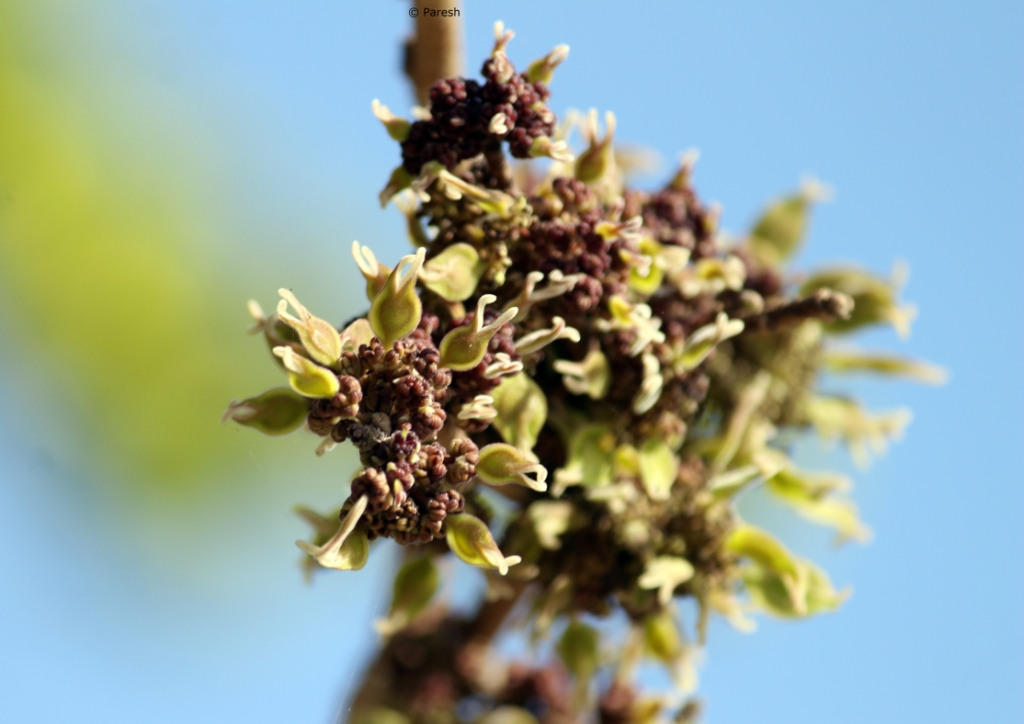
The tree is known for a refreshing drink prepared from the
fruits, commonly known as Phalsa Sherbet or squash, is considered a delicacy
throughout the hot summer months in India. The Phalsa tree (Grewia
Asiatica/फालसा) is a
small-to-moderate sized deciduous tree.

Phalsa is a beautiful tree with small orange-yellow
flowers, borne in densely crowded axillary cymes. The ripe fruits are eaten as
a dessert. Their taste and flavor are very much liked. Due to fruits, the tree is often found pollarded to keep its branches low and within reach.
According to Ayurveda, different parts of this plant possess
different pharmacological properties. Leaves have antimicrobial, anticancer,
antiplatelet and antiemetic activities; fruit possess anticancer, antioxidant,
radio-protective and anti-hyperglycemic properties; while stem bark possesses
analgesic and anti-inflammatory activities. The fruits are a cooling tonic, astringent
& aphrodisiac; they allay thirst & burning sensations, remove
biliousness, cure inflammation, heart & blood disorders and fevers. The
fruit is also good against throat trouble. The bark is used as a demulcent,
febrifuge and treatment for diarrhea. It cures urinary troubles and relieves
burning sensation. The root bark is employed in treating rheumatism. The leaves
are applied on skin eruptions and they are known to have antibiotic action.
The tree improves the soil and also aids in reclamation of
degraded land. It has been proved that the plantations of Phalsa increased
organic Carbon, available Nitrogen, Phosphorus & Potassium in the soil and
reduced Calcium Carbonate, pH & bulk density due to litter production
greater than that of other fruit trees. It is propagated easily by seeds.
Phalsa can be grown on a wide range of soils, even those
that are slightly alkaline, clay or sandy soils. But for fruit production,
ideal is a rich alluvial soil. The tree grows in both tropical and subtropical
climates but will tolerate other climates, except at high altitude; however, it
does best in regions having distinct summer and winter seasons. It is very
hardy, drought-tolerant species and capable of existing under severe conditions
and is suitable for arid regions.
The fresh leaves are valued as fodder. The mucilaginous
extract from the tree obtained after pounding in water is used to clarify
sugarcane juice during the preparation of gur, the traditional brown sugar made
in India.
Ropes or cordage can also be obtained from the tree. Furthermore, there is no
serious pest or disease of this species.
There is a similar close cousin of Phalsa from the same
genus, the Dhaman (Grewia Tiliifolia/धामण,
धामनी) is a moderate-sized
deciduous tree.

The yellow flower resembles the Phalsa flower very much. The
main difference is in the leaves. The leaves of Dhaman are oblique
heart-shaped.
The tree is harvested from the wild for local use of its
fibre and edible fruit. The black, globose, 2-3 lobed fruit is about the size of
a pea, having a nice flavor. Fruit is a good source of micronutrients such as
anthocyanins, phenols, flavonoids and vitamin C. They have a moderate
antioxidant activity and make an excellent, healthful addition to the diet.
Dhaman grows rapidly in full sun and light shade. It is
successful in a range of well-drained soils. It also serves as a larval host
plant for the Coladenia Indrani species of butterflies. It is also propagated by seeds.
The tree has numerous medicinal properties. It is employed
in dysentery & applied externally to remove irritation from itch. It also
has emetic properties. Leaves and twigs are lopped for fodder. The leaves
contain 1% tannin and are sometimes employed as a soap substitute for washing
hair.
Sandpaper Raisin or Rough-leaved Raisin (Grewia Flavescens/खटखटी) is a large shrub or small tree,
with beautifully bright yellow flowers. It is multi-stemmed and densely
branched, forming a very irregular leafy canopy. Leaves are simple, alternate, hairy
and light green on both sides, being more hairy underneath; with irregularly
toothed edges. The fruit is berry-like and hard. The skin of the fruit is said
to be the hardest amongst the Grewia species. The fruit are eaten by birds, especially
hornbills, and also by monkeys.
The species is also known for its ornamental value and is
used as a vegetable, fodder and to make baskets. The fruits are used as food
and for traditional medicinal treatments.
The fruits of Grewias attracts many birds and is also
consumed by monkeys and antelopes. Leaves are food plants for the larvae of
moth-like Skipper butterflies. The trees also serve as important pollinators, food
source for many animals and provide a good support for the ecosystem. These
species have high potential in agroforestry practices as well as have high
ornamental value. Hence it is great have one of these beauties near house!
 The Salai tree has beautiful flowers. But what is more attractive
is its bark or that’s what makes the tree easily identifiable. The bark is very
thin, greyish-green, ashy or reddish with a chlorophyll layer beneath the thin
outer layer, which peels off in thin, papery flakes. It gives a unique and
attractive appearance to the tree. Leaves are alternate, crowded towards the
ends of the branches; and very variable in size.
 It has been recorded as a new lac host species. It is a suitable species for afforestation on poorer soils
in areas of dry sandstone hills which have been denuded of vegetation. Under
such circumstances, its ability to withstand the adverse effects of forest
fires, its immunity to being browsed or lopped for fodder, and its power of
resisting the effects of insolation & drought are great assets.
 Salai can be propagated fairly well from seeds. Mature seeds
should be immersed in water before they are sown, to separate out the sterile
pyrenes, which float on the surface. Usually seed germination takes a week or
two. It also has the remarkable ability to sprout from large branch cuttings or
root suckers.