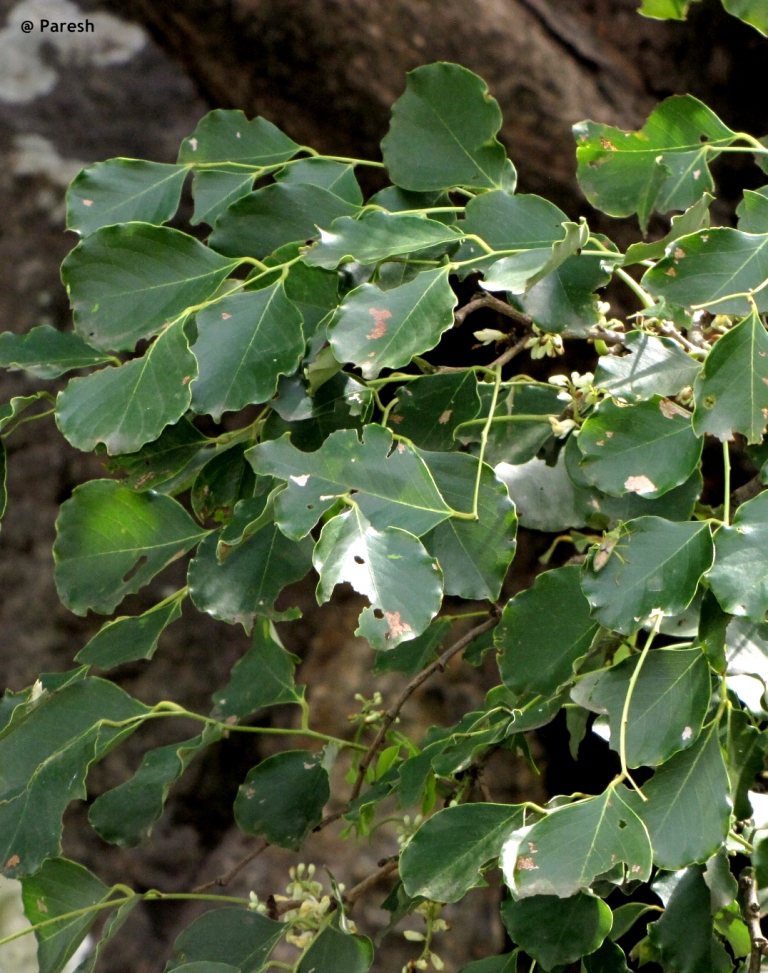
The Button tree or Dhok (Anogeissus Pendula/धोक, काळा धावडा) is a beautiful, moderate-sized species. With or without flowers, the tree is known for grace and beauty of its silky foliage. In winters before falling, the leaves turn a beautiful yellowish red. Every time you visit the tree, it appears surprisingly different!

Dhok is often confused with well-known Dhvada tree or rather, is recognized as Dhavda. It has variable bark. Dhok has tiny fragrant flowers in dense clusters. It is a dominant species on sloppy & rocky soils, as nothing else can survive there. It coppices & pollards well and the coppice shoots are fairly fast growing, although the tree grows slowly. It fruits abundantly but has low germination rate.
Despite having such a low regeneration capacity and a very tough growing conditions, the tree does something spectacular to regenerate. Mr. Pradip Krishen, the writer & environmentalist, finds the tree very unique and pretty. Under the soil surface, a tree sends out a horizontal stem, called a ‘stolon’ and from the end, a sapling roots. Such stems extend in every direction, spawning a colony of genetically identical trees. “It’s like the trees are holding hands. Button tree is more like a Banyan, which instead of sending aerial roots down, sends subterranean shoots up.” says Krishen.
Dhok is a very important tree species of the fragile eco-systems. It is a drought hardy plant that yields excellent animal fodder and other products like green dye and tannins. The tree is also known for many medicinal properties and has uses for ailments like dysentery, gastric disorders, skin problems, cough or for its anti-oxidant properties.
It has ecological significance for the Aravalli range and other hilly areas of the country, where it is difficult for other tree species to thrive. It is a hardy tree that can survive even in the extreme conditions.
Axlewood tree or Dhavda (Anogeissus Latifolia/
धावडा,
धव) is a similar beautiful species from same genus. It is a medium-to-large sized, deciduous tree.
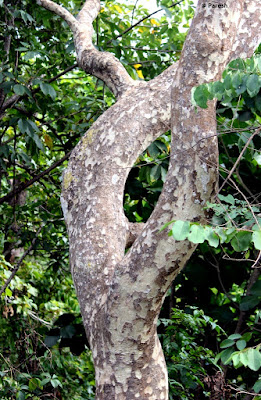
It is one of the most useful multi-purpose trees in
India. Axlewood also has tiny
beautiful fragrant flowers in dense clusters. But flowerless tree is also equally
attractive, mainly due to the bark. Its bark surface is smooth or with scales,
pale to dark gray and is mottled in a characteristic pattern. It has somewhat similar flowers and fruits as that of Dhok. Leaves are nearly
opposite on drooping branches.
The drought tolerant tree is also fire-resistant, but does
not tolerate water-logging. It is found on a variety of soils, but prefers deep
alluvial soils. The tree’s robust nature gives it the Sanskrit name Dridhataru! :)
It is usually mentioned as a possible agroforestry species.
Tussar silkworms are fed on its foliage, which is also used as fodder for
cattle and buffaloes. Its flowers are an important pollen source for bees. The
tree is a good survivor on eroded land. It is often used for river bank
stabilization. The tree improves the quality of soil wherever planted. Axlewood tree contributes
to soil nutrient cycle by exhibiting high leaf-litter decomposition rates.
Its leaves contain large amounts of tannin. The tree is the source of Indian
gum, also known as Ghatti gum. Ghatti gum is a good substitute for Gum-arabic
and is used in printing, for confectioneries, in dye processes and as a binding
agent in pharma industries. It also gives good quality charcoal.
Medicinally, the plant root pacifies vitiated kapha, vata
and abdominal disorders. The bark cures vitiated conditions of kapha and
vata, wounds and ulcers, inflammations, diabetes, haemorrhages,
haemoptysis, diarrhoea, dysentery, haemorrhoids, skin diseases, liver diseases
and general debility. Also it is reported to be used in treating snake bites
and scorpion stings in India.
Axlewood can be propagated by seeds and coppices. The seeds
are soaked in cold water for about 48 hours or 3-min hot water treatment is
done for successful germination. The tree produces root suckers, coppices and
pollards well.
Both these trees deserve far more attention as an ornamental and ecologically important trees. May be that's why these trees got their place on the 11th anniversary of
Gifting Trees...! :-)
 The flowers are white in colour, and just like the Coral Jasmine / Parijataka tree, bloom in the evening & fall down in the morning spreading the highly
scented wave of freshness in summer months of March to May. Even without
flowers, the tree shows off its glossy green leaves. It grows at moderate speed. This tree strongly needs
to be introduced in city gardens.
The flowers are white in colour, and just like the Coral Jasmine / Parijataka tree, bloom in the evening & fall down in the morning spreading the highly
scented wave of freshness in summer months of March to May. Even without
flowers, the tree shows off its glossy green leaves. It grows at moderate speed. This tree strongly needs
to be introduced in city gardens. The flowering of this tree is very profuse and fragrant. Its flower’s capsule appears nearly quadrangular, curved like a sickle, giving it an appearance of curved sheep horns, hence the name Medhsing or Bhershing. When in bloom, it attracts variety of birds and bees. It is easily propagated by its papery seeds.
 The tree is also known to have medicinal properties. It is
used to treat diabetes. The Father of
Surgery, Sushruta, had placed the Medhshingi tree in Shaalasaaraadi & Varunaadi Gana,
Shiro-virechana & Vaata Samshamana Varga; and describes its use particularly
in cataract, vision disorders, head diseases, wound healing and as an
anxiolytic.
The tree is also known to have medicinal properties. It is
used to treat diabetes. The Father of
Surgery, Sushruta, had placed the Medhshingi tree in Shaalasaaraadi & Varunaadi Gana,
Shiro-virechana & Vaata Samshamana Varga; and describes its use particularly
in cataract, vision disorders, head diseases, wound healing and as an
anxiolytic.